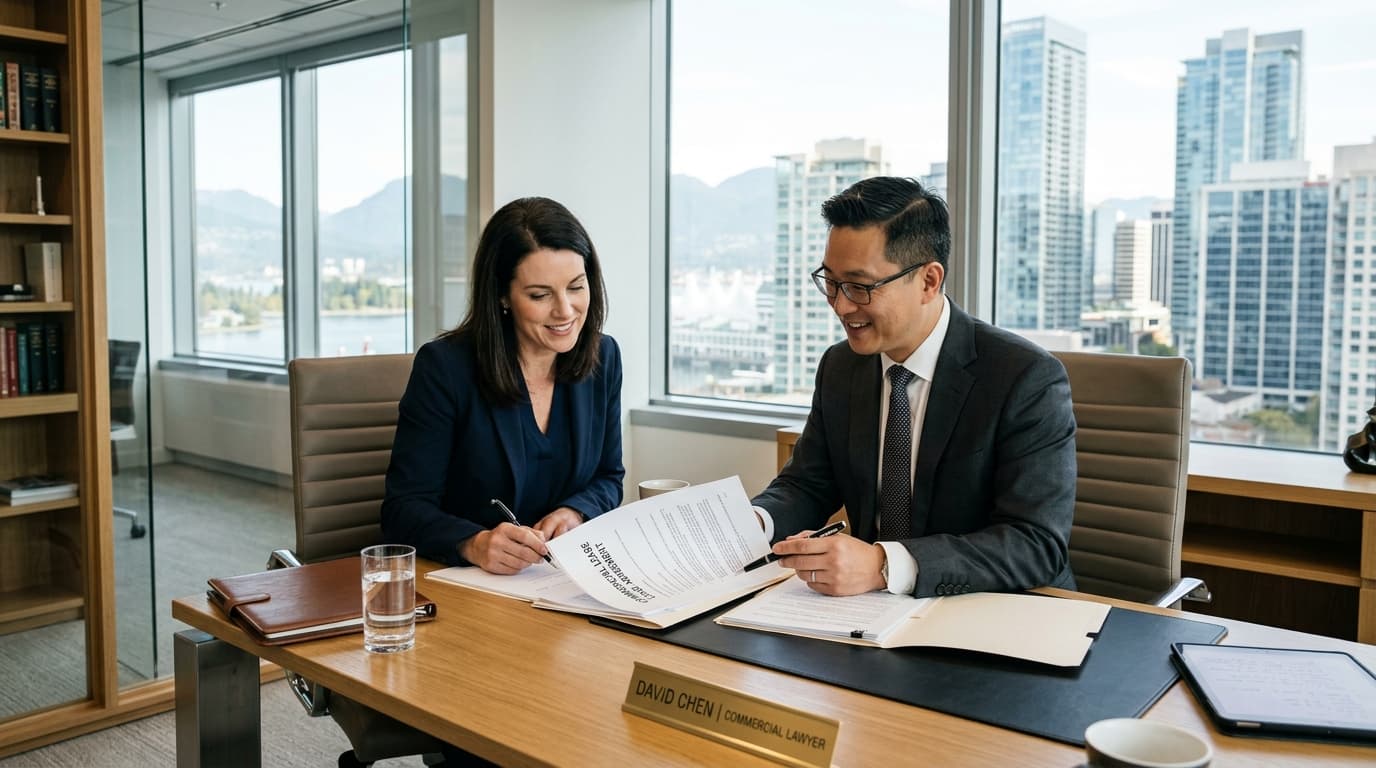
A commercial lease agreement defines the relationship between a business tenant and a landlord for years. In British Columbia, commercial tenancies operate under different rules than residential tenancies. There is no standard government lease form, no statutory rent increase ceiling, and no administrative tribunal like the Residential Tenancy Branch to settle tenancy arguments. The written agreement controls almost every right and obligation.
Before signing a commercial lease or a binding offer to lease, business owners must understand how rent is calculated, what liabilities they assume, and what remedies the landlord holds if problems arise.
How commercial leases differ from residential leases in BC
Residential rentals in British Columbia follow the Residential Tenancy Act, which sets strict caps on annual rent increases, limits security deposits to a half month of rent, and provides standard dispute resolution through the Residential Tenancy Branch.
Commercial rentals do not use those protections. Section 4 of the Residential Tenancy Act explicitly excludes living accommodation rented together with premises that are reserved primarily for business purposes. Instead, commercial arrangements fall under British Columbia's Commercial Tenancy Act and the common law of contracts.
Landlords can negotiate rent amounts, rent increases, deposit sizes, and operating cost allocations without statutory limits. If a dispute happens, the parties cannot take it to the Residential Tenancy Branch. They must resolve it through private negotiation, arbitration, or the courts.
Base rent and additional rent
Most commercial leases in BC divide financial obligations into two parts: base rent and additional rent.
Base rent is the fixed monthly charge for occupying the space. It is calculated as an annual dollar rate per square foot of leasable area, then divided into twelve monthly payments.
Additional rent covers the tenant's share of operating costs for the property. In a gross lease, the tenant pays a single flat amount, and the landlord absorbs operating costs. In a net lease or triple net lease, the tenant pays base rent plus a proportionate share of property taxes, building insurance, utilities, and common area maintenance.
When evaluating a lease, compare the total monthly outlay, not just the base rent figure. A low base rent with an open-ended additional rent clause can result in monthly costs that exceed your budget.
Operating costs and audit rights
Under a triple net lease, operating costs often fluctuate from year to year. Common expenses included in additional rent are:
- Municipal property taxes and local improvement levies
- Building insurance premiums
- Maintenance for shared spaces such as parking lots, roofs, and hallways
- HVAC repair and service contracts
- Property management administration fees
Tenants should review the definition of operating costs carefully. Major capital repairs, such as replacing a roof or structural foundation, belong to the landlord as capital expenditures unless the lease says otherwise. A fair agreement specifies whether capital expenses are excluded or amortized over their useful life.
You should also look for an audit clause. An audit clause gives the tenant the right to review the landlord's annual operating cost reconciliation statements and supporting financial records.
Personal guarantees and indemnity clauses
Commercial landlords routinely ask business owners to sign a personal guarantee or indemnity agreement, especially when the tenant is an incorporated company.
A personal guarantee makes the individual guarantor liable for all obligations of the tenant company. If your business runs into financial difficulty and cannot pay rent, the landlord can pursue your personal assets, including personal bank accounts and family property.
If a landlord demands a guarantee, you can try to negotiate boundaries:
- A monetary cap that limits the total dollar liability under the guarantee
- A time limit or burn-off clause that terminates the guarantee after a period of on-time payments
- Releasing the guarantor upon an approved assignment of the lease to a qualified buyer
Assignment and subletting clauses
An assignment transfers your entire lease agreement to a new party, such as when you sell your business. A sublease allows another business to rent part or all of the space while you remain the primary tenant.
Most commercial leases state that you cannot assign or sublet without the landlord's prior written consent. Check whether the lease specifies that the landlord cannot withhold consent unreasonably.
Pay attention to ongoing liability. In many standard lease forms, assigning the lease does not release the original tenant or guarantors from liability. If the buyer defaults on rent two years later, the landlord may still come after you. To prevent that outcome, seek a clause stating that the landlord releases the assignor from further obligations once a qualified replacement tenant takes possession.
Renewal options and market rent
An option to renew gives your business the right to extend the lease term before the initial period expires. Without an express renewal clause, the tenancy ends at the end of the term, and the landlord may lease the space to someone else or demand higher rent.
Review the notice window for exercising an option to renew. Most leases require written notice between six and nine months before the lease expires. Missing the deadline forfeits the option entirely.
Renewal clauses set the new rent at fair market rent. The agreement should define a dispute mechanism for market rent disagreements, such as an independent appraisal or binding arbitration.
Landlord remedies for unpaid rent
When a commercial tenant fails to pay rent, the landlord has remedies under the lease agreement and the Commercial Tenancy Act.
One statutory remedy is distress, also called distraint. Under section 3 of the Commercial Tenancy Act, a landlord can enter the rented premises, seize the tenant's goods, inventory, and equipment, and sell them to recover unpaid rent, without a prior court order. Section 4 requires that distress occur within six calendar months after the determination of the lease. The lease itself may add requirements or limit how distress is carried out.
Alternatively, the landlord can terminate the tenancy, re-enter the property, change the locks, and sue for arrears and damages. Under sections 18 to 28 of the Commercial Tenancy Act, landlords can apply to the Supreme Court of British Columbia for an order of possession against a tenant who wrongfully remains on the property after the tenancy ends.
Because these remedies are severe, commercial tenants must understand the notice and grace periods required before a landlord can declare a default.
Ending the lease and restoration clauses
Commercial leases contain restoration clauses, also known as make-good provisions. These clauses dictate what condition the premises must be in when the tenant vacates.
Some clauses require the tenant to remove all leasehold improvements, signs, and fixtures, and return the unit to a bare shell condition. Removing walls, specialized plumbing, or heavy electrical installations costs substantial money.
Ensure the agreement clarifies whether improvements made with the landlord's consent may remain at the end of the term, or whether full restoration is mandatory.
Commercial lease review with Pacific Point Law
Pacific Point Law reviews and negotiates commercial lease agreements for tenants and landlords across Surrey, Metro Vancouver, and the Okanagan. We assist clients with new leases, lease renewals, sublease agreements, assignment on business sales, and commercial tenancy disputes.
Consultations take place virtually on Google Meet or in person by appointment at our South Surrey or Kelowna offices. We assist clients in English, Hindi, Urdu, and Punjabi. Learn more about our business and commercial law services in Surrey or contact our Kelowna office.